Trading confluences stack liquidity, fair value gaps and structure into one repeatable edge
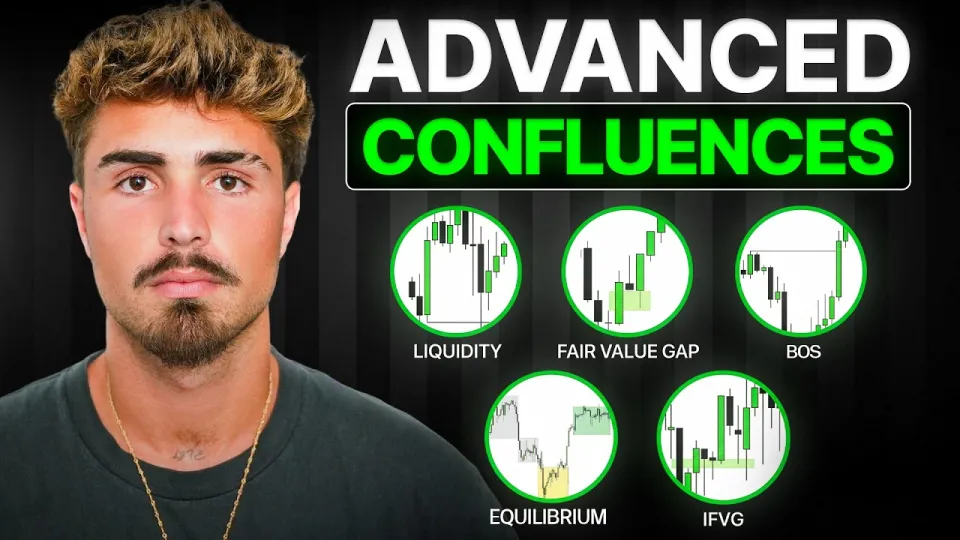
Video: Learn Every Trading Confluence In 18 Minutes
Want articles like this for your own video to promote it on YouTube and Google? Order them through the Telegram bot @sat_sit_bot. Articles with your video embedded are written and posted by the bot itself — on popular topical sites (no ads). Your first 50 articles are free.
Key takeaways
- Confluence means two or more independent signals agreeing on the same price area before you risk capital.
- The core set in TJR's 18-minute breakdown: liquidity, fair value gaps (FVG), inverse FVG, equal highs/lows and break of structure (BOS).
- A fair value gap is a three-candle imbalance where candle one's wick and candle three's wick do not overlap.
- Break of structure confirms direction; a sweep of equal highs or lows without displacement is a trap, not a signal.
- More confluences is not automatically better: each added filter cuts trade frequency and must earn its place in the data.
Trading with confluences means waiting until two or more independent signals point at the same price area before you take a position, instead of acting on a single pattern. The most common stack in modern price-action trading is liquidity, fair value gaps, inverse fair value gaps, equal highs and lows, and break of structure, the exact set TJR walks through in the 18-minute breakdown “Learn Every Trading Confluence In 18 Minutes”. If you want the full framework behind that stack, TJR's free trader blueprint is available at the full-time trader blueprint.
What a confluence actually is in trading
A confluence is agreement, not decoration: two signals that could each fail on their own but rarely fail together at the same level. A liquidity sweep into a fair value gap that also aligns with a higher-timeframe level is a confluence; a fair value gap on its own is just an imbalance. The practical test is independence. If two “confluences” are derived from the same candle pattern, they are one signal counted twice, and stacking them only creates false confidence. Traders who treat confluence as a checklist of ten items usually end up paralyzed, which is why the useful version is a short list of three to five concepts you can read in seconds on a live chart.
The five core confluences, one by one
These five building blocks cover most of what retail price-action traders call confluence, and each one describes a different mechanic of the market.
- Liquidity. Clusters of stop orders sit above equal highs and below equal lows, and large participants often push price into those clusters to fill size before moving the other way. A sweep that immediately reverses is information; a sweep that keeps going is a trend.
- Fair value gap (FVG). A three-candle imbalance where the wick of candle one and the wick of candle three do not overlap, leaving a gap in the middle candle's range. Price frequently returns to that gap before continuing, which makes it a reference zone rather than a guarantee.
- Inverse fair value gap. When price trades through an FVG and then respects it from the other side, the gap flips role: former support becomes resistance, or the reverse. That flip is a confirmation signal, not an entry on its own.
- Equal highs and equal lows. Two or more highs or lows at nearly the same price mark obvious liquidity. They are magnets before a move and traps during one.
- Break of structure (BOS). A close beyond the most recent swing high or low that changes the sequence of the trend. BOS tells you direction; the other four tell you where.
How to combine confluences into a single setup
A workable setup is a sequence, not a pile: context first, then the level, then the trigger. Start on a higher timeframe to define direction, drop to your execution timeframe, mark the obvious liquidity pools and unmitigated gaps, and only then wait for a trigger such as a break of structure or a rejection from an inverse FVG. A typical long looks like this: price sweeps equal lows, displaces upward through a swing high (BOS), leaves an FVG behind, pulls back into that gap, and holds it. Four confluences, one story, one invalidation point below the sweep. If the story needs a fifth and sixth reason to sound convincing, the setup is probably not there.
Why more confluences can make you a worse trader
Adding filters always reduces trade count, and it only improves results if the filters carry real information. The honest way to test this is a trading journal: tag every trade with which confluences were present, then compare win rate and average risk-to-reward across tags after at least 50 trades. Most traders discover that one or two concepts do the heavy lifting in their market and timeframe, while others add nothing but missed entries. A viewer comment on the video makes the same point more bluntly: the skill is knowing which confluences actually add value to your strategy. Treat that as an empirical question about your own data, not a matter of opinion.
Common questions traders raise about confluence trading
Risk management outranks confluence, and the viewers who ask about it are right to. A perfect five-confluence entry with no stop and oversized position is still a losing trade waiting to happen, so define invalidation before entry and size the position from that distance. The second recurring doubt is whether confluence trading works at all given how manipulated markets can look; the answer is that confluence does not predict the future, it structures where you are willing to be wrong. The third is the emotional side: several traders describe months of losses before consistency, and a written process with a fixed checklist is what makes that period survivable. Finally, backtest and forward-test on a demo or funded evaluation account before scaling, because a concept that reads clearly on a chart still needs sample size to prove itself in your hands.
Useful links
- TJR full-time trader blueprint — the structured system behind the confluence framework.
- Indicators TJR uses daily — the chart tools referenced in the breakdown.
- Funded account raffle entry — contest form for a funded account.
- Alpha Futures signup — 10% off funded accounts.
- Lucid Trading — 40% off.
- Tradeify — 30% off funded accounts.
- TradeZella trading journal — the journal used to tag and review setups.
- HeroFX broker — the broker referenced in the video description.
Bottom line
Confluence trading is a filtering discipline: liquidity, fair value gaps, inverse FVGs, equal highs and lows, and break of structure each answer a different question, and your edge comes from the few combinations that repeat in your own journal. Learn the concepts individually until you can spot them without indicators, then test combinations on a sample large enough to trust. TJR's 18-minute walkthrough is a fast way to see the whole set in one place, and the blueprint is where that set becomes a full process. Day trading is risky and most day traders lose money, so treat every confluence as a probability, not a promise.
Source: Learn Every Trading Confluence In 18 Minutes · Markdown version
Questions & answers
How many confluences should a single trade have?
Most traders do better with two to four independent confluences rather than a long checklist. Each added filter reduces how often you trade, so it must measurably improve your win rate or risk-to-reward in your own journal data. If a filter cannot show that after a decent sample, drop it.
Is a fair value gap a buy or sell signal on its own?
No. An FVG marks an imbalance where price may return, but it says nothing about direction or timing by itself. It becomes actionable when combined with context such as a liquidity sweep, a break of structure, or a higher-timeframe level, and when you have a clear invalidation point.
What is the difference between a break of structure and a liquidity sweep?
A break of structure is a close beyond the last swing high or low that changes the trend sequence, so it confirms direction. A liquidity sweep is a push into a cluster of stops above equal highs or below equal lows that often reverses quickly. A sweep with no displacement is usually a trap; a sweep followed by a BOS is a setup.
Can confluence trading work without strict risk management?
No. Confluence improves the quality of your entries but cannot protect an oversized position or a missing stop. Define invalidation before entry, size positions from that distance, and cap daily losses so a single wrong read cannot end your account.