7 Essential Steps for Successful Trading with AI Crypto Bots
Key takeaways
- AI trading bot uses Claude AI to scan decentralized exchanges for arbitrage opportunities
- Bot automatically executes trades on Ethereum blockchain via smart contracts
- Tested continuously over months showing real-world profitability potential
- Setup involves deploying AI agents for scanning and executing trades
- Practical guide suitable for beginners interested in AI and crypto trading
Trading with AI has become one of the promising ways to make money online, especially in the volatile crypto market. This article outlines 7 essential steps to successfully trade using AI crypto trading bots, based on Ryan Walker's real test results with a Claude AI-powered bot that performs crypto arbitrage on Ethereum.
1. Understand How AI Trading Bots Work for Crypto
AI trading bots automate the process of scanning multiple decentralized exchanges (DEXs) to find price discrepancies between tokens. These bots leverage AI agents to identify arbitrage opportunities—buying tokens at a lower price on one exchange and selling them at a higher price on another instantly. The Claude AI bot discussed operates by sending trade instructions directly to smart contracts on the Ethereum blockchain, ensuring fast and trustless execution.
2. Deploy and Set Up the AI Trading Bot
Setting up an AI trading bot involves deploying two main AI agents: a searcher and an executor. The searcher continuously scans DEX pools for price differences, while the executor carries out transactions once an opportunity is found. Deployment requires some familiarity with Web3 technologies and smart contract interactions on Ethereum. Ryan Walker provides a detailed step-by-step guide and full code resources at https://tr.ee/WkRwnw to help beginners get started.
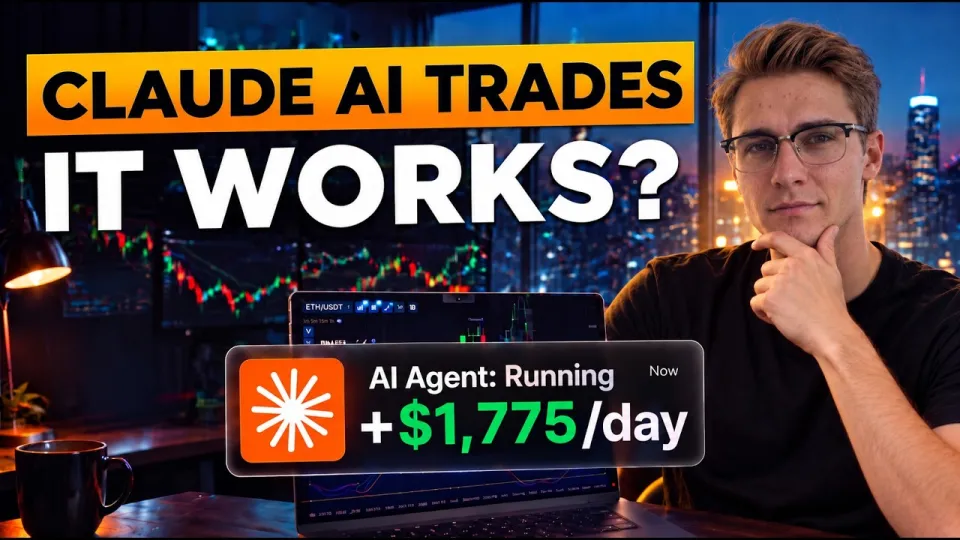
Video: How To Make Money online? I Built an AI Trading Bot for Crypto Trading (Real Test Results)
3. Monitor and Optimize Bot Performance
During testing, Ryan monitored the bot's real-time activity across multiple pools, which helped improve the logic and efficiency of trade identification. Continuous monitoring is crucial to adjust parameters such as gas fees optimization and adding more chains or DEXs to expand opportunities. Optimizing these settings can significantly enhance profitability and reduce operational costs.
4. Understand Crypto Arbitrage and Risks
Crypto arbitrage involves exploiting price differences across exchanges, but it comes with risks such as transaction delays, slippage, and fluctuating gas fees on Ethereum. The AI bot mitigates some risks by instant execution through smart contracts, but traders must remain aware of market volatility and possible losses. Always conduct thorough research and risk management before deploying capital.
5. Leverage AI for Scalability and Speed
AI trading bots excel by scanning data faster and more comprehensively than humans. Using Claude AI agents enables scalable monitoring of multiple DEXs simultaneously, identifying fleeting arbitrage chances quickly. This speed advantage is critical in crypto markets where price gaps close in seconds.
6. Practical Tips for Beginners Using AI Trading Bots
For those new to AI trading, start with small capital and test the bot in simulated environments if possible. Learn the basics of blockchain, smart contracts, and how decentralized exchanges work. Utilize existing open-source codebases like Ryan Walker's to avoid common pitfalls and customize strategies over time. Community support channels, such as Ryan's Telegram (https://t.me/RyanW_web3), provide valuable help.
7. Evaluate Test Results and Decide Your Strategy
Ryan's AI trading bot was tested continuously for over 13 hours with real trades executed on Ethereum, showing promising profit potential through crypto arbitrage. Analyzing these results helps traders understand expected returns and refine strategies accordingly. Remember that no bot guarantees profits, and ongoing development is necessary to adapt to market changes.
Useful Links
- Full resources and code: https://tr.ee/WkRwnw
- Support and questions: https://t.me/RyanW_web3
Summary
Trading with AI crypto bots involves deploying intelligent agents that scan decentralized exchanges for arbitrage opportunities and execute trades on Ethereum smart contracts. Ryan Walker's project demonstrates how Claude AI can be harnessed to automate profitable crypto trading with transparent real test results. By following the 7 essential steps—understanding bot mechanics, deployment, optimization, risk management, scalability, beginner tips, and result evaluation—you can explore ways to make money online with AI trading bots effectively. For full setup instructions and code, visit https://tr.ee/WkRwnw. This practical guide is based on Ryan Walker's educational content and real trading experiments.
Source: How To Make Money online? I Built an AI Trading Bot for Crypto Trading (Real Test Results) · Markdown version
Questions & answers
How does the AI trading bot identify profitable trades?
The AI trading bot uses Claude AI agents to continuously scan multiple decentralized exchanges for token price differences, identifying arbitrage opportunities where it can buy low on one exchange and sell high on another almost instantly.
Is deploying an AI trading bot complicated for beginners?
While some blockchain and smart contract knowledge is helpful, Ryan Walker provides step-by-step instructions and full code resources to make deployment accessible for beginners interested in AI-based crypto trading.
What are the risks involved in AI crypto trading bots?
Risks include market volatility, transaction delays, slippage, and fluctuating gas fees on Ethereum. Although the bot automates execution to reduce delays, traders must still perform due diligence and manage risks carefully.
Can AI trading bots guarantee profits in crypto trading?
No, AI trading bots do not guarantee profits. They improve efficiency and speed to exploit market inefficiencies but require ongoing optimization and risk management to adapt to changing market conditions.